
White Etching Cracks

Summary

White etching cracks (WECs) are a form of subsurface-initiated rolling contact fatigue failure in hardened bearing steels. They are most commonly observed in rolling element bearings operating near motors or generators, particularly in wind turbine drivetrains.

In WEC failures, cracks typically initiate below the surface, often at a non-metallic inclusion and grow until they reach the raceway surface, forming pits or spalls. Unlike classical bearing fatigue, WEC failures often occur well within the intended design life of the bearing.

The definitive root cause of WEC formation remains unresolved. Current understanding suggests that WECs arise from a combination of mechanical loading, tribochemical reactions, and electrical effects. They are identified metallographically using serial sectioning techniques, where characteristic white etching areas (WEAs) become visible beneath the surface.

What Are White Etching Cracks?

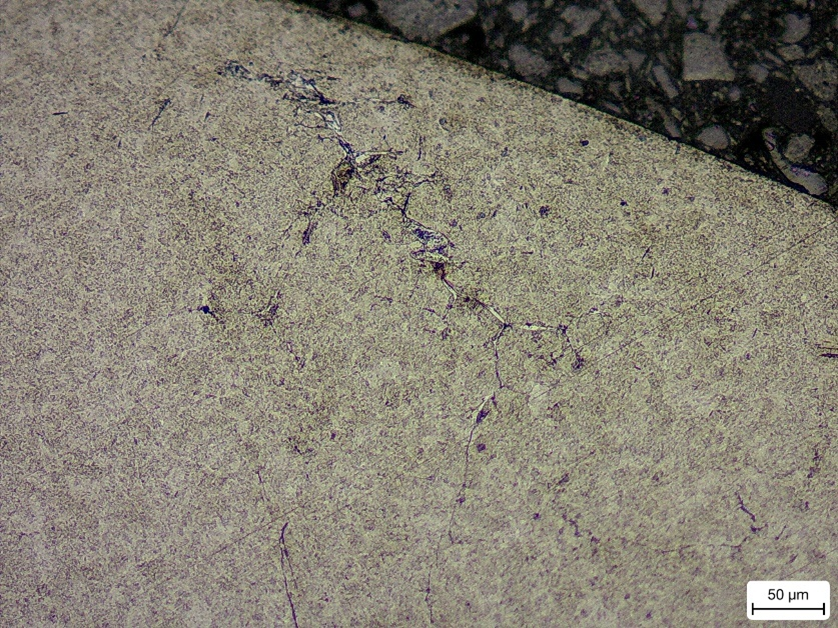
White etching cracks consist of a network of subsurface cracks surrounded by regions of altered microstructure known as white etching areas (WEAs). These crack networks are typically associated with subsurface features such as non-metallic inclusions.

A typical WEC network contains:

  • A dominant crack running roughly parallel to the raceway surface
  • Numerous secondary cracks branching in multiple directions
  • Localised WEAs surrounding portions of the crack network

The white etching area is composed primarily of hard ferrite. After polishing and chemical etching, the surrounding martensitic steel etches dark, while the ferritic WEA remains bright, producing a distinctive white appearance under optical or electron microscopy.

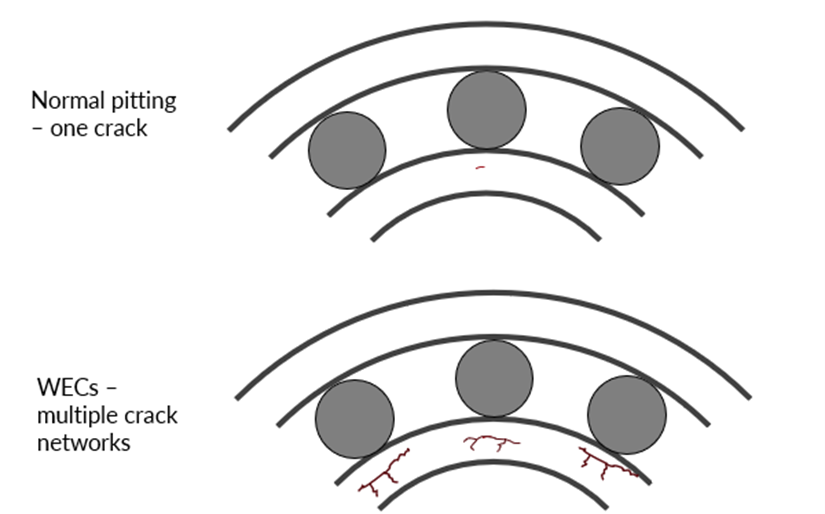
In components affected by WECs, many such crack networks are usually present, rather than a single isolated defect.

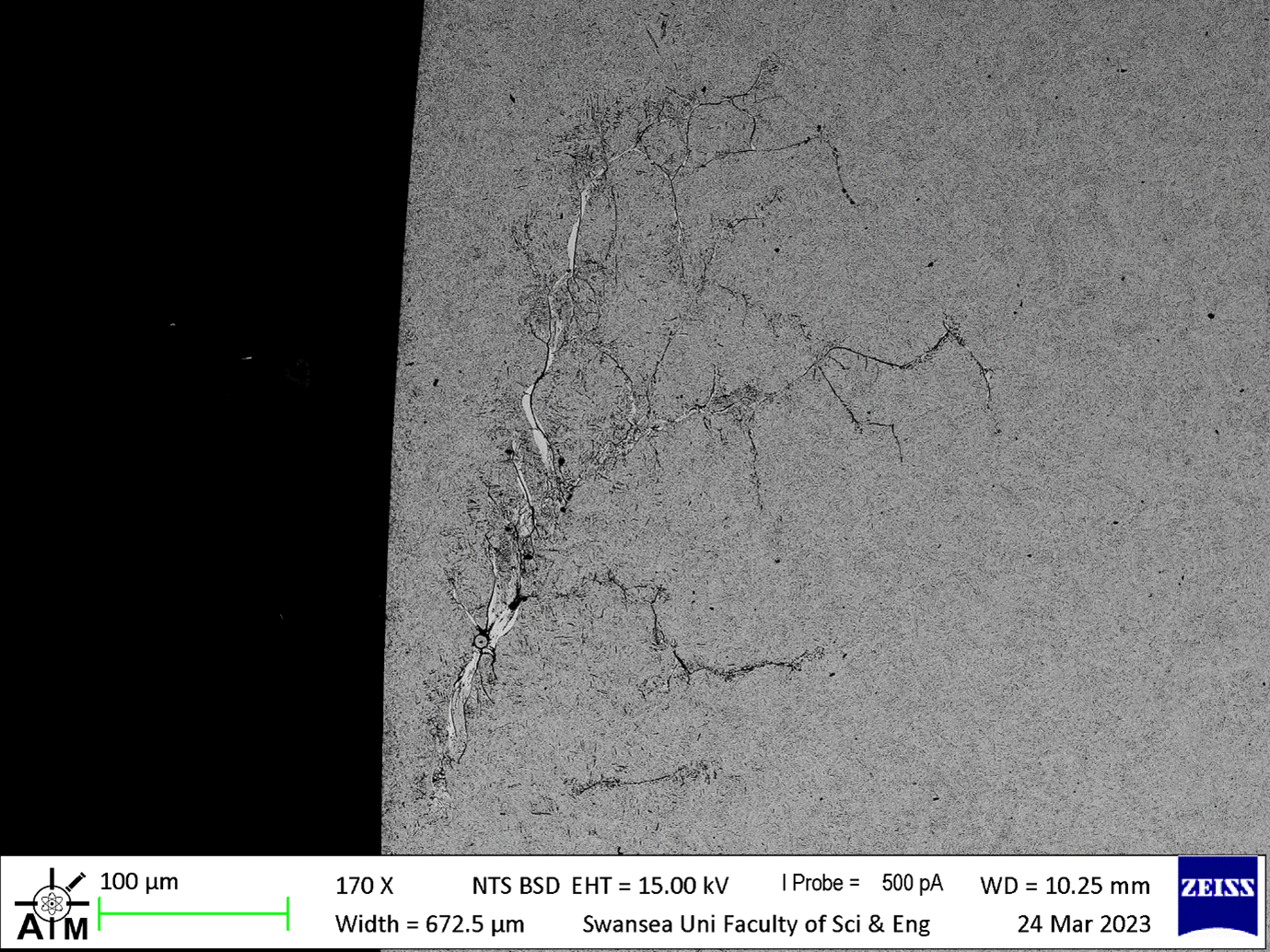
An example SEM image (taken at AIM, Swansea University) illustrates the characteristic features of WEC damage. A small non-metallic inclusion appears to act as the initiation site, with two early-stage “butterfly wings” forming around it. From this region, cracks propagate both parallel to the surface and deeper into the material. Portions of the crack network are bordered by WEAs, indicating significant local microstructural transformation. With continued rolling contact, these subsurface cracks eventually coalesce with the surface, producing a spall or pit.

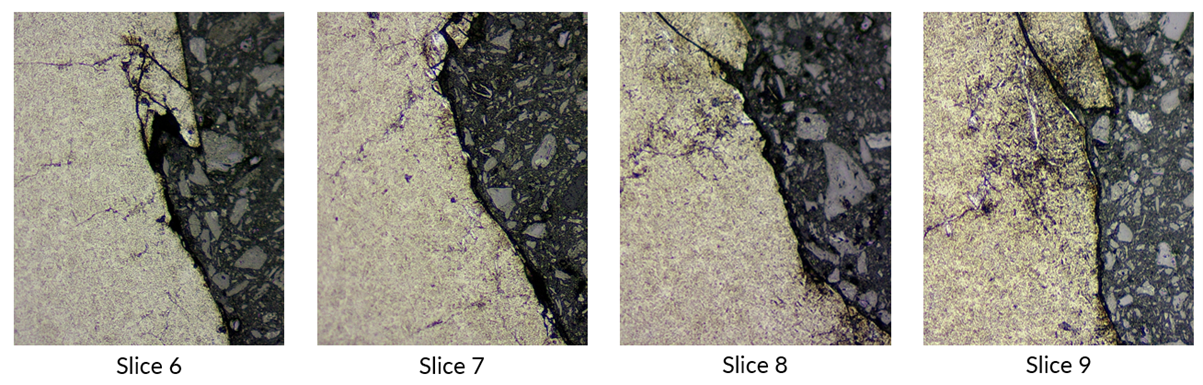
Serial sectioning of a pitted roller (shown below) shows that these crack networks extend through the subsurface. Each section—taken approximately 100 µm apart—reveals a different cross-section of the same interconnected damage structure.

How Is This Different from Classical Pitting?

At first glance, WEC failures may appear similar to classical subsurface-initiated pitting, a mechanism that has been well understood for decades. The key differences between the two mechanisms is how the cracks form, how many initiation sites exist, and how the bearing fails statistically.

Classical Subsurface Initiated Pitting

  • Typically one initiation site
  • One dominant crack leading to one initial pit
  • Subsequent damage may occur as debris circulates
  • Follows a wear-out failure distribution
  • The majority of bearings (>90%) survive beyond their calculated design life

White Etching Crack Failures

  • Multiple initiation sites distributed throughout the component
  • Many crack networks develop simultaneously
  • Cracks are surround by white etching area
  • Leads to multiple axial cracks and surface pits
  • Failure statistics show early mortality
  • Indicates an accelerated damage mechanism, rather than normal fatigue

In WEC-affected bearings, crack networks are often found around the entire circumference of the rolling element or raceway. This indicates that the steel itself has been compromised, making the formation of multiple surface spalls essentially inevitable.

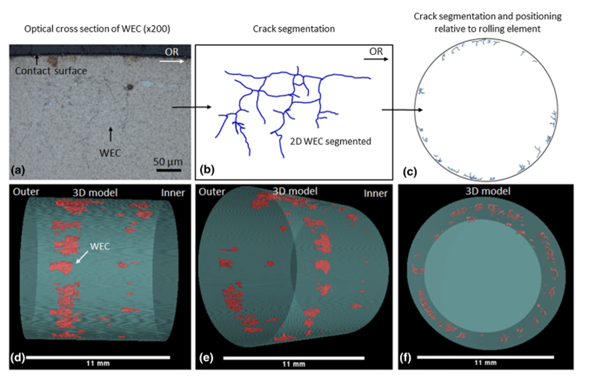
Work by Richardson (1) shown below clearly demonstrates the abundance of crack networks below a steel surface. This was achieved by mapping the location of all crack networks in a single roller specimen, showing widespread subsurface damage long before catastrophic surface failure occurred.

What Causes White Etching Cracks?

In field applications – most notably wind turbines – WEC formation is believed to be driven by a combination of mechanical, electrical, and chemical influences.

Mechanical Drivers

  • Transient overloads causing short-duration high contact pressures
    (e.g. grid disconnections, emergency stops, wind gusts)
  • High slip or sliding within the bearing during transient operation
  • Edge loading due to misalignment or deflection

Electrical Drivers

  • Electrical discharge events
    High current or voltage events can create surface damage that locally increases subsurface stress
  • Stray currents
    Lower-level currents can disrupt tribofilm formation, accelerate lubricant degradation, and promote hydrogen generation

Chemical Drivers

  • Water contamination, which can act as a source of hydrogen
  • Lubricant formulation
    Some additive chemistries are associated with increased WEC susceptibility
    Oils that form robust, low-friction tribofilms tend to reduce WEC risk
  • Lubricant oxidation, which may generate hydrogen as a by-product

Competing Theories of WEC Formation

It is increasingly accepted that WEC formation may be multi-modal, with different mechanisms dominating under different operating conditions.  The most popular theories include hydrogen embrittlement, transient overloads and electrical current effects. 

Hydrogen Embrittlement

Hydrogen diffuses into the steel, reducing ductility and promoting crack initiation and branching. Hydrogen may originate from water contamination or lubricant degradation.

Stress History and Transient Overloads

The transient nature of the wind turbine mechanical system may cause short-duration, high-stress events.  These will result in very high pressures or increased sliding in the bearing and may initiate subsurface cracks. These cracks then propagate slowly under normal loading. One hypothesis suggests that rubbing of crack faces contributes to the formation of the white etching area.

Electrical Current Effects

WECs have been generated experimentally under moderate direct and alternating currents (≈250 mA). Electrical currents may:

The electrical current is known to effect tribofilm formation, possibly hindering it, promoting metal-on-metal contact, which could then lead to higher friction and higher stresses in the subsurface.  The lack of a robust tribofilm may also lead to the accelerated oxidation of the lubricant, forming hydrogen. 

Current Mitigations in the Field

Lubrication-Based Approaches

  • Additive chemistries less prone to hydrogen generation
  • Improved oxidative stability
  • Controlled lubricant conductivity and polarity
  • Reduced water content (typically <200–300 ppm)
  • Adequate film thickness and correct viscosity
  • Avoidance of overheating

Materials and Surface Engineering

  • Ultra-clean steels (fewer inclusions)
  • Optimised heat treatments
  • Protective coatings (e.g. black oxide, DLC, ceramic coatings)

What Can the Lubricant Do?

The lubricant plays a central role in mitigating WEC formation. Beyond reducing friction and wear, it must form a robust tribofilm capable of maintaining low friction under:

  • High loads
  • Sliding conditions
  • Variable electrical environments

Effective tribofilms help control subsurface stress fields and reduce metal-to-metal contact. This not only limits crack initiation and propagation but may also suppress lubricant degradation pathways that lead to hydrogen generation.

Weibull Statistics and WEC Failures

Weibull statistics are commonly used to describe fatigue failures in rolling contact systems.

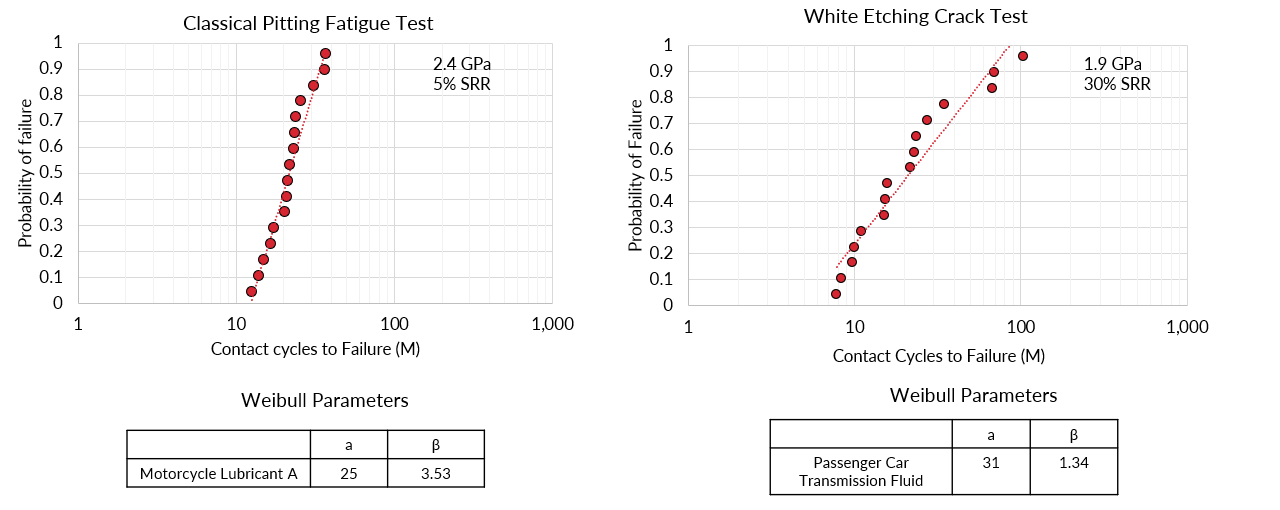
In classical pitting tests, the distribution of cycles to failure is relatively narrow, with a Weibull slope β ≈ 3, characteristic of wear-out behaviour.

In contrast, WEC-type tests exhibit a much lower Weibull slope (β ≈ 1). This indicates early failures, with some specimens failing very quickly while others survive much longer. This statistical signature reinforces the view that WECs represent an accelerated failure mechanism, rather than normal rolling contact fatigue.

The test results shown below use a 3 ring on roller test machine with multiple repeat tests.  The classical pitting fatigue test results are taken from the data by Smeeth (2) which uses a SRR of 5% and 2.4 GPa, with 10W-40 motorcycle oils.  The white etching crack tests use a SRR of 30 % and 1.9 GPa, and a 75W80 transmission oil. 

Laboratory Testing of White Etching Cracks

WECs can be reproduced at laboratory scale using specialised test methods, typically with deliberate acceleration strategies:

  • High slide-roll ratios
    (e.g. ~30% SRR on MPR or high-slip configurations in FE8 tests)
  • Hydrogen charging of steels
  • Use of known “bad reference oils” (3)
  • Lower cleanliness steels with higher inclusion content
  • High contact pressures applied early in the test (4)

These approaches allow WEC behaviour to be studied within practical test durations, albeit under deliberately severe conditions. If you would like to learn more about WEC and how we are helping people solve them, please get in touch.

  1. Richardson, A.D., Evans, MH., Wang, L. et al. The Evolution of White Etching Cracks (WECs) in Rolling Contact Fatigue-Tested 100Cr6 Steel. Tribol Lett 66, 6 (2018). https://doi.org/10.1007/s11249-017-0946-1
  2. Smeeth, M., “The Rolling Contact Fatigue Behaviour of Motorcycle Lubricants,” SAE Technical Paper 2014-32- 0117, 2014, doi:10.4271/2014-32-0117.
  3. https://www.stle.org/files/TLTArchives/2019/04_April/Cutting_Edge.aspx
  4. Francesco, M., The Origin of white etching cracks and their significance to rolling bearing failures,”  Int. J. Fatigue., 120, (2019) 107-133.  https://doi.org/10.1016/j.ijfatigue.2018.10.023

Gear Micropitting Screening Test

Micropitting is a type of fatigue wear commonly found on gear teeth. The gradual loss of material in the form of small surface pits leads to a change in the geometry of the component; if this is not controlled, it can result in failure of the part.

The standardised method of evaluating a lubricants ability to reduce micropitting is with a back-to-back gear machine (the FZG Gear Test).  This test for micropitting is very long – in the order of 3-4 weeks. 

We have developed an accurate and repeatable accelerated micropitting test.  Which is being used to help lubricant formulators develop new products, in a fast and cost-effective manner.

This test method uses the PCS Instruments MPR, in a 3 ring on roller configuration. 

The loss of material of our test roller “MPR Profile Deviation” correlates with the gear profile deviation as measured in the FZG FVA 54/7 or DIN 3990 part 16 method.  This gives oil formulators a useful and accurate tool to develop new lubricants.

If you would like to hear more, please get in touch. [email protected]

Maintaining safe and quiet railways

We are currently working on an exciting project with the Railway Standards Safety Board (RSSB) and the European Lubricating Grease Institute (ELGI), to develop a new performance test for Top of rail (TOR) materials.  These TOR materials are used to ensure traction and reduce noise at the wheel/rail interface.  This allows trains to start without the wheels spinning and stop without skidding.  The use of TOR materials is primarily a safety concern, but they can also reduce the squeal emitted by the train wheels in curves.

Our new test uses creep curves to evaluate the performance of TOR materials.  The test consists of ball and disc loaded against each other and driven independently, while measuring the friction force acting between them. The linear speeds at the point of contact of both the ball and disc can be varied from being equal to a difference of 10%. This difference in speed introduces sliding into the contact and produces the creep curves. The height of the creep curve gives an indication of the traction available for the train, while the shape of the creep curve can give an indication of noise. Eleven top of rail materials were tested using the method to show the difference in their expected performance in the field.  These materials were supplied blind-coded.

An example of the creep curves is shown in the figure below:

After testing it was revealed that samples A, G, H and J were the TOR materials approved for use in the field, and would be expected to perform well in this test.  Samples F and L are “dual products” – those which can be used on both flange and TOR.  Samples B, C, D, E and K are flange products, expected to have low traction.  The four TOR materials can be identified easily from the creep curves, as they all produce higher traction in this system.

This method is now being considered for addition to the DIN EN 16028 standard “Railway applications –Wheel/rail friction management –Lubricants for trainborne and trackside applications”

Want to know more? Download the paper

Stribeck Curves

A Stribeck Curve (sometimes also called a Stribeck Friction Curve) is a common name used to described friction vs entrainment speed results, measured on a tribometer.  These are very useful as they give a good overview of the frictional performance of a lubricant.

The Stribeck Curve is named after the German engineer Richard Stribeck, who conducted pioneering research on lubrication and friction in the early 20th century.

The variation in speed allows friction to be measured across the main lubrication regimes, as shown in the diagram below:

In the boundary regime the load between the two surfaces is supported at the surface asperities.  Friction is dominated by the properties of the surface and any surface active additives.  In the elastohydrodynamic (EHL) regime the load is supported by the fluid film.  Friction is controlled by the physical properties of the lubricant.  In the mixed regime the load is supported by a mixture of the surface asperities and the fluid film.

Stribeck curves can be used to quickly assess the lubricants ability to reduce friction in the boundary, mixed and EHD lubrication regime.

An example Stribeck curve taken for 3  very different fluids is shown below:

In this example the boundary and mixed regime can be clearly seen for the classic motor oil (blue) and the heady duty engine oil (orange).  The heavy duty engine oil showing higher overall friction in the boundary and mixed regime.  The axle fluid shows very low friction in the boundary and mixed regime.  At higher speeds ~ 3000 mm/s, the friction in the EHD regime for the three oils is similar.

Common effects in MTM type Stribeck curves:

Stribeck curves can be used to measure and investigate a large range of different effects.  These include surface active additives, which will control friction in the boundary regime and the position of the mixed regime.  Base oil viscosity and viscosity index improvers can vary the position of the curve (at a constant speed).  Some of the more common effects studied using Stribeck curves are shown here…

Friction Modifiers

Additives such as organic friction modifiers reduce friction in the boundary and mixed regime:

Antiwear additives / ZnDDP

Thick tribofilm forming additives, such as ZnDDP can increase the roughness of the surface and extent the speed at which the contact remains in the boundary and mixed regime.  Pushing the curve to the right.

Viscosity

Increasing the viscosity of the oil has the effect of keeping the contact in full film lubrication to lower speeds.  Pushing the curve to the left:

Using Stribeck curves to compare lubricant formulations

Stribeck curves are commonly used to study fully formulated products.  This can give an indication of how the combination of different additives effects the friction in the boundary and mixed regime, along with the position of the mixed regime.

The Stribeck curves formed by 6 different 5W30 engine oils are shown below:

This type of result can be used by lubricant formulators and chemists to directly compare oils.  For this particular result – it can be seen that lubricants MTMD003, 16,17 and 19 have a very similar frictional performance in the boundary regime.  Lubricants MTMD003 and 16 have a similar response in the mixed regime (200 – 3000 mm/s) suggesting a similar thickness and morphology tribofilm.  The same can be said for MTMD003 and 18.

Lubricant MTMD018 has a slightly lower boundary friction coefficient – and interestingly the friction increases with speed (an effect sometime seen with friction modifier type additives).

Lubricants MTMD017 and 20 have a lower overall friction coefficient in the mixed regime – an effect which is likely due to the formation of a thinner tribofilm – or very little tribofilm.  This is commonly observed with ashless type antiwear additives.

Traction Curves

Traction curves can be used to develop lubricants for specific applications, for example high traction fluids for CVTs.  They can also be used to help understand the physical changes of the lubricant under high contact pressures.  This can then be used to help develop new lubricants with special properties, for example with low traction to help in machine efficiency.

The measured traction depends on the physical properties of the lubricant in the central film area.  Under EHD conditions the lubricant film experiences high pressures and high shear rates momentarily.  Traction curves gives an approximation of how the EHD film shear stress varies with strain rate.

An example of a idealised traction curve is shown below:

traction curve diagram

At lower SRRs the strain rate is small and the fluid is considered Newtonian.  Hence as the proportion of sliding increases, so does the strain rate along with the shear stress of the fluid.  This results in an increasing measured traction.  This is the linear region.

At higher SRRs the strain rate becomes significant, resulting in shear thinning.  The shear stress of the EHD film cannot exceed a critical value called the “limiting shear stress”.  This results in the levelling out of the traction curve, indicated by the isothermal region.  The limiting shear stress is dependent on the molecular structure of the lubricant.

The example of a traction curve below uses a high traction fluid – Santotrac 50.  This fluid consists of a high traction cyclic hydrocarbon structure.

Traction curve example - Santotrac 50

Traction curves can be used to compare the EHD traction of different base oil formulations.  This type of measruement can be linked to machine efficiency.  The plot below shows some traction curves formed by engine oils, with different base oil composition.

Traction curve - base oil effects

As the traction curves are lowered, a gain is expected in machine efficiency – especially those with a large number of non-conformal EHD contacts.

Traction curves are also used frequently in rolling element bearing research.  The traction forces in the bearing influence the fatigue performance of the surface.  Traction curves can be used to find suitable lubricants and greases to reduce the shear forces on the bearing surfaces, extending their lifetime.

We can conduct traction curves in the following test envelope:

Temperatures: ambient – 150 °C

Speeds: 0 – 4 m/s

Contact pressures: Up to 1.25 GPa with steel specimens (up to 3 GPa with WC)